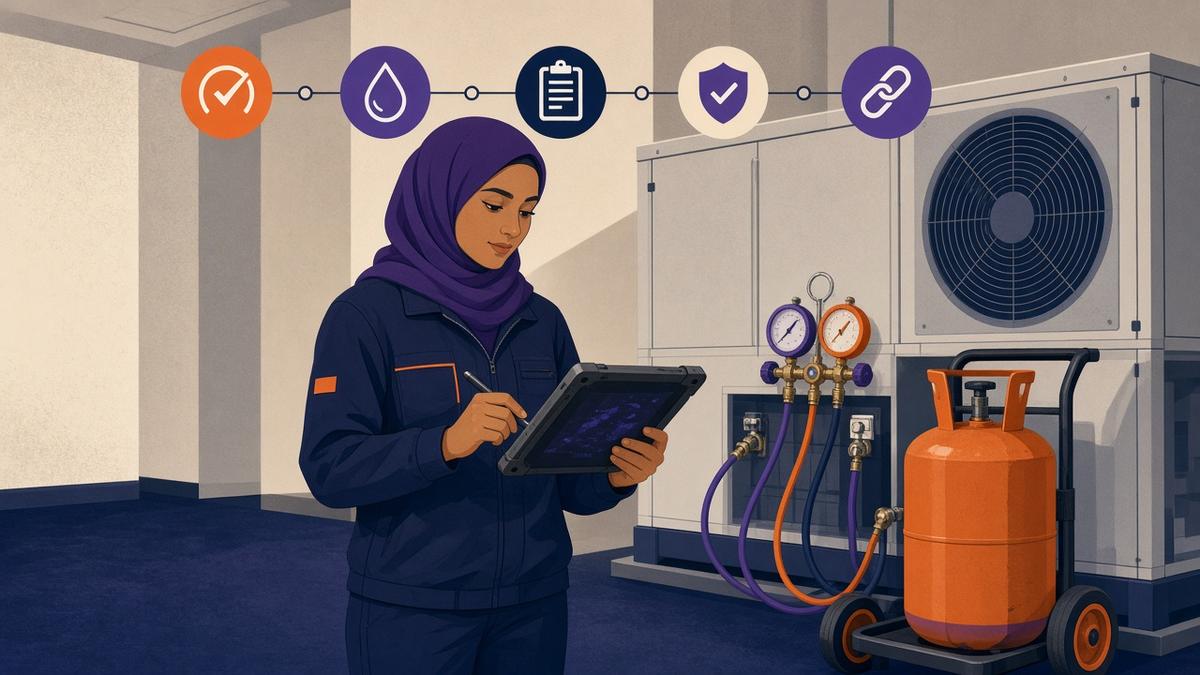
Why Your HVAC Business Stalls Between 30 and 80 Techs (and It’s Not the Work)

You’ve got the work. Maintenance contracts are renewing, the phones are busy, and you’ve just signed two new commercial sites. So you hire five more techs.
Three months later, revenue is up a little, but not by five techs’ worth. Your scheduler is working until 7 pm. Service reports are piling up waiting to be formatted. Completed jobs sit for days before they’re invoiced. And you’re back in the office every evening making the calls nobody else can make.
That’s a growth ceiling. It’s one of the most frustrating stages for an HVAC business, because it feels like you’re doing everything right. You’ve got demand and you’ve got people. The business just won’t go any faster.
The pipe is only as wide as its narrowest point
Think of your business as a pipe. Work comes in (calls, contracts, PMs due), goes through dispatch (scheduling, reschedules), out to the field (techs on the tools), through the office (reports, invoices, quotes), and ends up as cash (paid invoices).
Hiring techs widens the field section. But if dispatch or the office stays the same width, the extra work just queues up there. You’ve paid for more capacity and moved the bottleneck.
Four places the ceiling usually sits
Dispatch
- One or two people hold the whole schedule in their heads
- Reactive calls regularly bump planned work
- Techs ring the office to find out where to go next
Our HVAC dispatching guide covers this stage in more depth.
Planned maintenance
- The next month of PM is planned less than two weeks ahead
- Missed PM visits are found by the client, not by you
- Nobody can say how many PM hours are due next quarter
An annual preventive maintenance plan is the starting point for fixing this one.
Office and invoicing
- Service reports are retyped or reformatted before sending
- Completed jobs wait days to be invoiced
- Every new contract means more admin headcount
Much of that admin is double data entry, and our free Service Manager Workflow Optimizer helps you map where office hours actually go.
Visibility and the owner
- Job and contract profitability lives in a spreadsheet
- Key decisions wait for the owner to be back in the office
- Client reporting is built by hand each month
Tick the symptoms you recognise. The section with the most ticks is your current ceiling. Fix that one before adding headcount anywhere else.
Find your ceiling before you hire. The free Growth Ceiling Diagnostic includes the full symptom checklist, four questions to answer before your next round of hiring, four ratios to track and a 12-month PM capacity planner.
What’s stopping a 50-technician business from reaching 100?
At that size, the limit is rarely “we can’t find enough work”. It’s whether scheduling, planned maintenance, quoting and the office can handle a larger field team without you adding a person in the office for every person in the field.
The diagnostic walks through those ceiling points, plus a PM capacity planner you can reuse, so you can see what has to change before the next round of hiring.

Four questions to answer before you hire the next five techs
- Who will schedule their work, and how many more techs can that person take on?
- How many extra reports, quotes and invoices a week will they create, and who handles them?
- Is there enough planned work booked to keep them busy in the quiet months?
- How will you know, within 90 days, whether each new tech is profitable?
If you can’t answer one of these with confidence, that’s probably where the ceiling is. For question 1, our guide to job scheduling for HVAC businesses covers scaling the schedule without more staff. For question 3, our free Revenue Growth Formula is built around filling the off-season with repeat service work.
Track your own ratios, not someone else’s benchmark
You don’t need industry averages to spot a ceiling. You need your own trend, tracked alongside the HVAC KPIs you already watch. Measure these four today and again in 12 months:
- Techs per scheduler: field techs ÷ people who schedule or dispatch
- Techs per office admin: field techs ÷ admin FTE (reports, invoicing, quoting)
- Job complete to invoice: median days from job closed to invoice sent
- PM planned ahead: share of next month’s PM visits already scheduled today
If techs per scheduler or per admin is falling as you grow, the office is scaling in a straight line with the field. That’s the ceiling, in one number.

Plan PM capacity before the work arrives
Planned maintenance is the backbone of most commercial HVAC businesses, and it’s lumpy. Quarterly visits on rooftop units and splits, monthly visits on chillers and cooling towers, six-monthly on exhaust fans. Some months stack up. Others leave techs short of work.
The diagnostic’s 12-month planner lists each asset class, its visit frequency from your contracts, and the months visits fall due. Then it compares PM hours due with available tech hours for each month:
PM load % \= PM hours due this month ÷ (techs × available hours per tech this month)
The frequencies in the planner are placeholders to show the layout. Take real frequencies from your contracts and the maintenance standard you work to, such as the current DA19 edition in Australia.
Once you can see which months are overloaded and which are light, hiring stops being a reaction to a busy fortnight and becomes a plan.
Five ceiling breakers
- Generate PM visits from the asset register, not from memory.
- Give techs the schedule, job history and checklists on their phone, so they stop ringing the office.
- Produce client reports straight from completed records.
- Invoice the day the job closes, synced to accounting.
- Put contract profitability on a screen, not in a spreadsheet.
Each one widens the office or dispatch end of the pipe without adding a desk. Tools like maintenance auto-scheduling, mobile job scheduling and invoicing synced to Xero or MYOB help, but the first step is knowing which section of the pipe is narrowest.
Raise the ceiling without raising headcount
More techs aren’t always the answer. Sometimes the right move is to fix the narrow point first, so the next five hires actually turn into revenue.
Download your free Growth Ceiling Diagnostic
Get the free Growth Ceiling Diagnostic. A symptom checklist, four pre-hiring questions, four ratios to trend and a 12-month PM capacity planner, for HVAC businesses scaling from 30 to 80+ technicians. Send me the diagnostic
Want to work through your ceiling and capacity plan together? Book a discovery call.
What You Should Do Now
- Book a Demo. You’ll be in touch with an automation expert who has worked in this space for over 5 years, and knows the optimal workflow to address your needs.
- If you’d like access to free articles about managing HVAC workflows, go to our blog.
- If you know someone who’d enjoy reading this page, share it with them via email, Linkedin, Twitter, or Facebook.